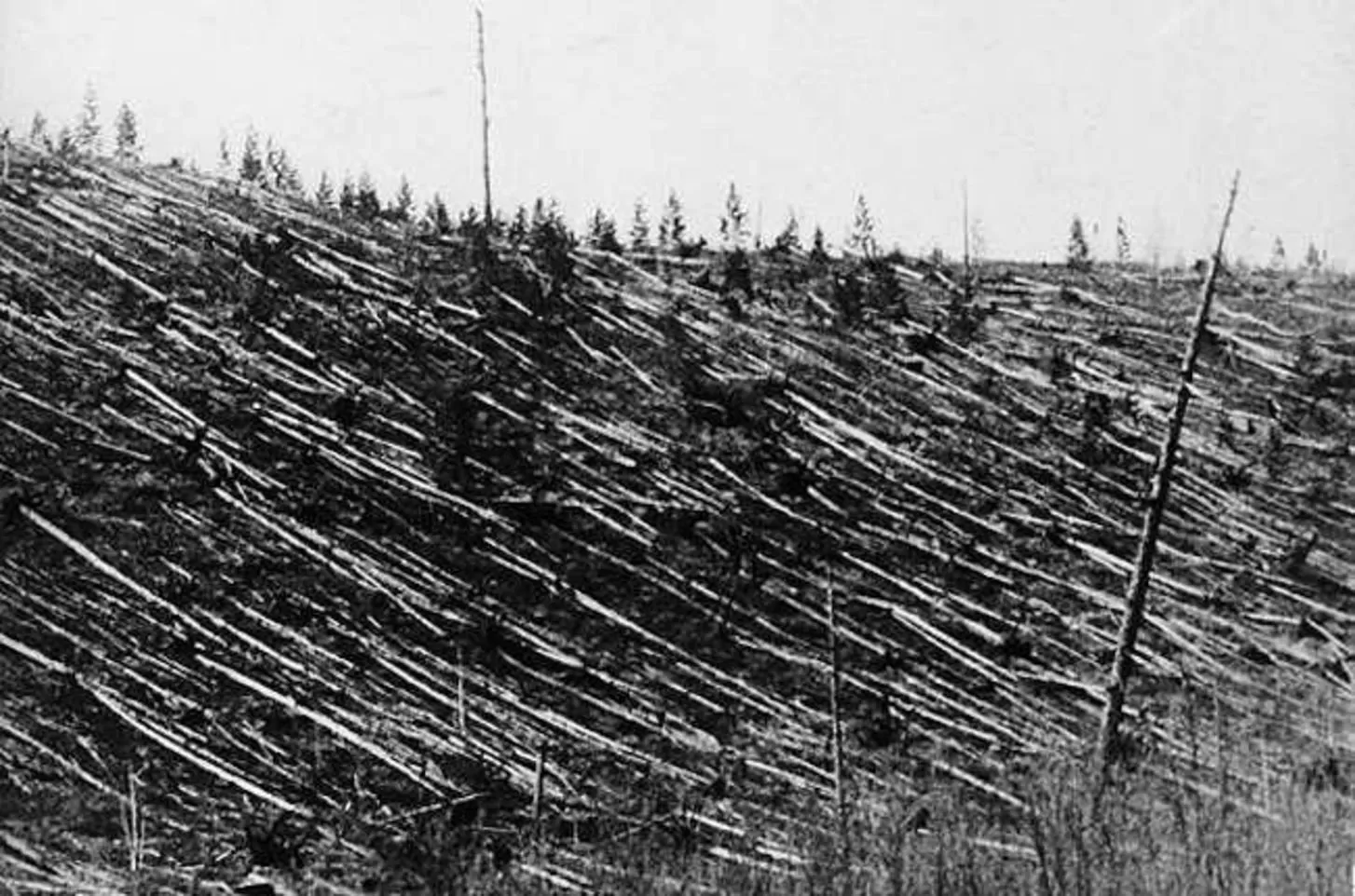
On the morning of June 30, 1908, a massive explosion occurred in a remote area near the Tunguska River in Siberia, Russia. This catastrophic event flattened an estimated 80 million trees over an area of 2,150 square kilometers (830 square miles) and generated a shockwave that was felt hundreds of miles away. The Tunguska Event, as it came to be known, remains one of the most enigmatic occurrences in modern history, sparking numerous theories about its cause. Eyewitnesses reported seeing a fireball streaking across the sky, followed by an ear-splitting explosion that caused the ground to tremble. The intense heat and light reportedly set vegetation ablaze and created atmospheric effects observable as far away as Europe. Some accounts described a “pillar of fire” and an orange-glowing sky, which lingered for hours after the explosion. Villages located over 60 kilometers away experienced shattered windows and buildings trembling from the blast’s shockwave. Despite its magnitude, the event left no obvious impact crater, adding to the mystery of what truly happened and fueling decades of speculation.
The Witness Accounts and Initial Reactions
Let’s dive deeper into the fascinating testimonies of those who were there. Many indigenous Evenki and Russian settlers in the area recounted similar experiences of being thrown off their feet by the force of the blast. These accounts were often delivered with a mix of awe and fear, reflecting the sheer surprise of such an unexpected event. The Tunguska Event was not just a scientific curiosity but an immediate and terrifying reality for those who lived through it.
In the weeks following the explosion, there was little in the way of an immediate scientific response, largely due to the remoteness of the region and the political climate of the time. Russia, embroiled in political turmoil leading up to the First World War and subsequent revolution, had limited capacity to investigate such phenomena. News of the event spread slowly, and it would take nearly two decades before the first scientific expedition reached the area.
Leading Scientific Theories
Over the years, scientists have proposed several explanations for the Tunguska Event. The most widely accepted theory involves a cosmic origin, suggesting that the explosion was caused by a meteoroid or comet fragment entering Earth’s atmosphere.
Meteoroid Airburst Hypothesis
According to this theory, a space rock approximately 50-60 meters in diameter exploded mid-air at an altitude of 5-10 kilometers (3-6 miles) above the surface. The rapid compression and heating of the atmosphere caused the meteoroid to disintegrate in a fiery explosion, releasing energy equivalent to 10-15 megatons of TNT—roughly 1,000 times more powerful than the atomic bomb dropped on Hiroshima. This explanation accounts for the widespread devastation and the absence of an impact crater. Additionally, researchers have simulated similar airburst events, such as the 2013 Chelyabinsk meteor, which provided comparative evidence.
The Chelyabinsk event offered modern scientists a rare opportunity to study an airburst in real-time, allowing for detailed comparison with Tunguska. The Chelyabinsk meteor was smaller, yet it still caused substantial damage and injuries, lending weight to the airburst hypothesis for Tunguska.
Cometary Origin
Some researchers suggest that the object was a fragment of a comet composed primarily of ice and volatile compounds. As the comet approached Earth, the intense friction and heat caused it to vaporize before reaching the ground, explaining the absence of an impact crater and the unusual atmospheric effects, such as glowing skies observed thousands of kilometers away. Observations of cometary disintegration events in recent decades lend credibility to this idea.
Comets, being less dense than asteroids, often disintegrate without leaving solid debris. The Leonids and Perseids meteor showers, for instance, are examples of comet fragments entering Earth’s atmosphere, providing a visible but non-destructive parallel.
Asteroid Fragment
Another plausible explanation is that an asteroid fragment entered Earth’s atmosphere. Unlike a comet, an asteroid is composed of denser material, which could explain the localized destruction and the significant release of energy upon disintegration. Studies of asteroid impact scars on other planets suggest that fragments as small as 50 meters in diameter could cause similar devastation.
Asteroids, like the one believed to have caused the Chicxulub crater, show that even relatively small objects can have outsized impacts, making this hypothesis a compelling explanation for Tunguska.
Alternative Explanations
While the cosmic impact theories remain dominant, alternative explanations have also been proposed. These ideas range from the plausible to the speculative, highlighting the enduring mystery of the event.
Volcanic Gas Eruption
Some researchers theorize that a massive release of natural gas from the Earth’s crust, combined with an atmospheric spark, could have caused the explosion. However, this theory struggles to account for the eyewitness reports of a fireball and the intensity of the blast. Furthermore, the lack of geological evidence supporting such a gas eruption weakens its validity.
In regions with active volcanism or geothermal activity, gas eruptions can occur. However, the geological setting of Tunguska does not support such activity, making this explanation unlikely.
Mini Black Hole
A more speculative idea suggests that a small black hole passed through the Earth, releasing energy as it interacted with the planet’s atmosphere. Proponents argue that this could explain the lack of physical debris and the radial pattern of destruction. However, the hypothesis lacks strong empirical evidence and remains highly controversial within the scientific community.
The concept of a mini black hole is intriguing but problematic. Such an event would likely have caused more widespread geological and atmospheric disturbances than were observed.
Alien Intervention
Some conspiracy theories propose that the event was caused by extraterrestrial activity, such as an alien spacecraft crashing or using advanced technology. While intriguing to some, these ideas are generally dismissed by the scientific community due to a lack of credible evidence and the absence of any technological remnants.
Alien intervention remains a popular theme in science fiction but lacks the empirical support needed for serious scientific consideration.
Antimatter Explosion
A less-discussed theory involves antimatter. If a chunk of antimatter collided with Earth, the resulting annihilation would release an immense amount of energy. However, no physical traces or corroborating evidence supporting this hypothesis have been discovered, making it an unlikely explanation.
Antimatter is a reality in particle physics, but its natural occurrence in sufficient quantities to cause such an explosion on Earth is highly improbable.
Investigations and Expeditions
The first scientific expedition to the Tunguska site was conducted in 1927 by Russian mineralogist Leonid Kulik. Kulik’s team documented the extensive destruction, noting the radial pattern of fallen trees consistent with a powerful explosion. However, they found no evidence of a crater. Kulik hypothesized that the explosion might have been caused by a meteorite that vaporized upon impact, leaving behind no large fragments.
Subsequent Expeditions and Findings
Subsequent expeditions in the mid-20th century focused on analyzing tree growth anomalies, magnetic field disturbances, and traces of extraterrestrial materials, such as micro-meteorite fragments. Researchers also studied soil samples, which revealed elevated levels of rare elements often associated with meteoric debris. These findings lent strong support to the cosmic impact theories.
In the 1950s and 1960s, Soviet scientists conducted more detailed surveys, utilizing newly developed techniques to measure residual magnetism and anomalies in tree growth rings. These studies revealed accelerated growth in trees surrounding the blast site, potentially due to nitrogen enrichment from the airburst.
Technological Advancements and Modern Research
Advancements in satellite imaging and computer modeling in recent decades have provided additional insights. High-resolution simulations of airburst scenarios have closely matched the observed effects at Tunguska, reinforcing the meteoroid and comet hypotheses. Further studies of the site have also revealed long-term ecological changes, such as the accelerated growth of surviving trees, possibly due to nitrogen enrichment from the explosion.
The use of computer simulations has allowed scientists to recreate the event under various scenarios, further narrowing the likely causes. These models have been instrumental in understanding the dynamics of airbursts and their impact on Earth’s surface.
Cultural and Scientific Impact
The Tunguska Event has had a profound impact on scientific research, inspiring advancements in planetary defense and the study of near-Earth objects. It serves as a stark reminder of the potential hazards posed by cosmic bodies. In recent years, programs like NASA’s Planetary Defense Coordination Office and international efforts to track asteroids have been partly motivated by the lessons learned from Tunguska. Efforts to identify and deflect potential impactors continue to be a priority for global space agencies.
Influence on Popular Culture
The event has also captured the imagination of the public, influencing popular culture in various ways. Books, movies, and television shows have drawn on the mystery of Tunguska to create compelling narratives. Conspiracy theories and speculative fiction continue to thrive, ensuring that the event remains a topic of fascination. It is often depicted as a pivotal moment in Earth’s relationship with extraterrestrial threats, blending scientific curiosity with human intrigue.
From appearing in video games to being the central theme of science fiction novels, the Tunguska Event has become a symbol of the unknown and a testament to the mysteries of our universe.
Lessons for the Future
The Tunguska Event underscores the importance of preparing for potential cosmic threats. While the probability of a similar event occurring is low, the consequences could be catastrophic if it were to happen near a densely populated area. Ongoing efforts to monitor and mitigate the risks posed by near-Earth objects are crucial for safeguarding the planet.
Interdisciplinary Research and Preparedness
Moreover, the event highlights the importance of interdisciplinary research, combining astronomy, geology, and atmospheric science to better understand these rare but significant phenomena. Despite more than a century of study, the Tunguska Event remains a captivating mystery. As technology advances, future research may finally uncover the true cause of this extraordinary phenomenon, providing valuable insights into Earth’s vulnerability to extraterrestrial forces and deepening our understanding of the universe.
Practical Steps in Planetary Defense
Today, efforts in planetary defense include tracking potentially hazardous asteroids and developing technologies to alter their paths. The Double Asteroid Redirection Test (DART) mission, for instance, aims to test our ability to deflect an asteroid, which could be a crucial step in preventing future impacts.
By learning from events like Tunguska, humanity is better equipped to face the challenges posed by our cosmic neighborhood, ensuring that we are not caught unprepared should another celestial visitor come calling.
Conclusion
The Tunguska Event remains a topic of intense scientific interest and public fascination. Its legacy is one of caution and curiosity, driving us to explore the mysteries of space and our place within it. As we continue to seek answers, the lessons of Tunguska remind us of the power and unpredictability of our universe.