Before the gleaming grandeur of Alexandria ever lit up the Mediterranean coast, there was another jewel of Egypt — one that controlled trade, worshipped gods, and welcomed empires. This was Thonis-Heracleion, an ancient city that for centuries was spoken of only in passing, dismissed by many as myth or exaggeration. For nearly 1,200 years, its existence remained submerged both literally and metaphorically — lost beneath the sea and forgotten in the annals of history.
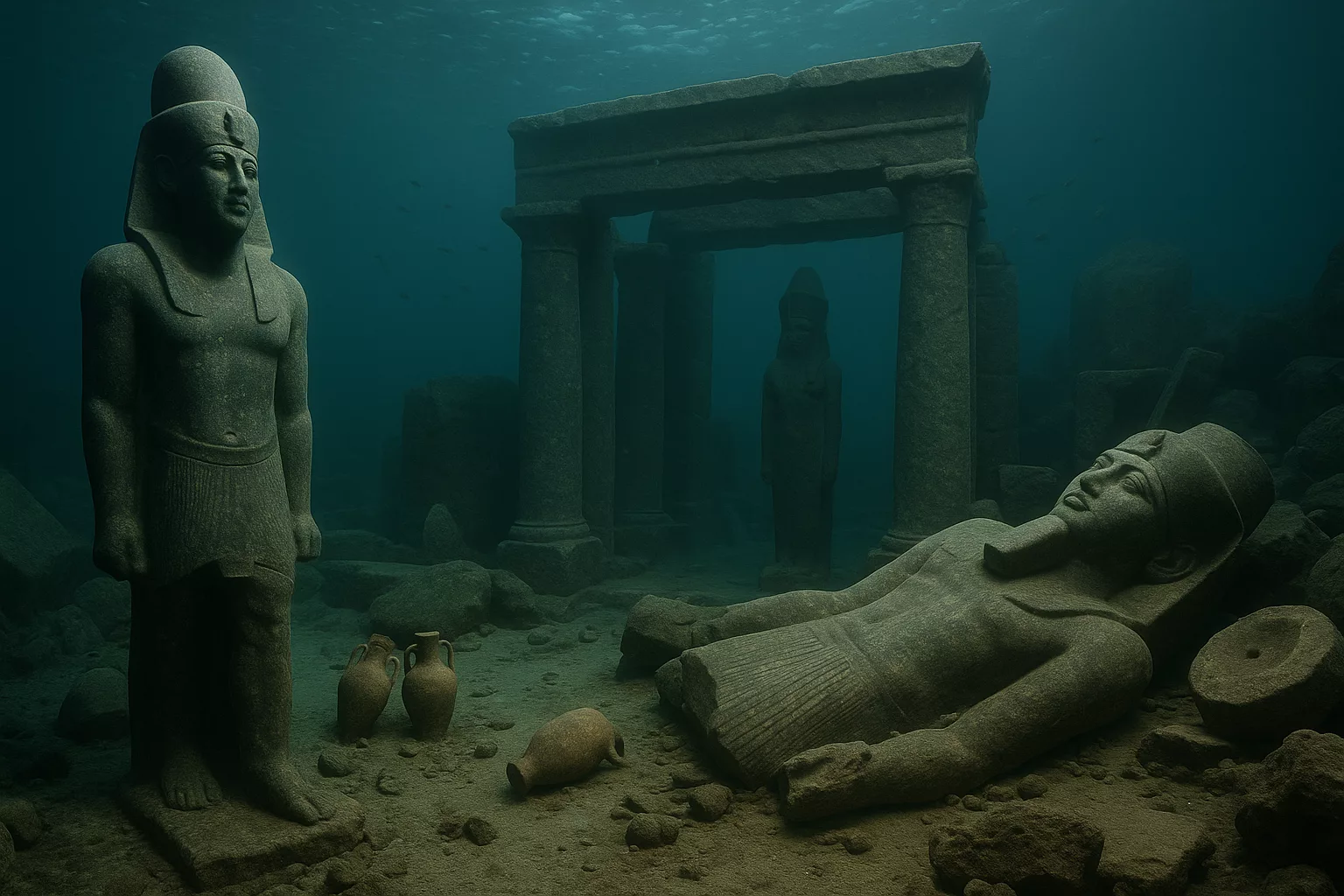
Then, in the year 2000, a team of underwater archaeologists led by Franck Goddio made a stunning discovery off the coast of Egypt: colossal statues, crumbled temples, and everyday objects scattered across the seabed. They had found Heracleion — the Greek name for what Egyptians knew as Thonis. This city wasn’t legend. It was real. And its story, pieced together from the ruins, is one of unimaginable grandeur, sudden catastrophe, and historical resurrection.
Where Was Thonis-Heracleion?
Thonis-Heracleion was once the largest port city in ancient Egypt, located in what is now Aboukir Bay, roughly 6.5 kilometers off the current coastline. At its peak around the 6th to 4th century BCE, it was the primary gateway for trade between Egypt and the Mediterranean world, predating even Alexandria. It sat near the mouth of the Nile River, strategically positioned at the crossroads of commerce and culture, where Greek, Egyptian, and other Mediterranean civilizations converged.
The city had a dual identity: to the Egyptians, it was Thonis, and to the Greeks, it was Heracleion, named in honor of the demigod Heracles, who, according to legend, had once visited the site. This blending of Egyptian and Hellenic names is a reflection of the cultural fusion that occurred in the city, especially during the Late Period of Egyptian history, when Greek influence intensified.
A City of Gods and Gold
Thonis-Heracleion wasn’t just a port — it was a religious and cultural hub. At its heart stood the Temple of Amun-Gereb, one of the largest religious complexes in the region, dedicated to the supreme god Amun. It was here that pharaohs would seek divine approval before ascending the throne. Sacred rituals, offerings, and processions were a part of daily life. Egyptian priests walked the grand causeways; oracles interpreted dreams and divine messages; pilgrims traveled from across the Nile Delta to pay tribute.
But Thonis-Heracleion was also a place of commerce and wealth. It levied taxes on goods entering Egypt via the sea and acted as a checkpoint for all foreign ships. Merchants from Greece, Phoenicia, Cyprus, and beyond would dock in its busy harbors, unloading cargoes of wine, grain, linen, and incense. The city thrived on trade, and its wealth was evident in the sheer scale and quality of the artifacts later found submerged — including massive red granite statues, gold coins, and ceremonial vessels.
The People and Their Lives
The population of Thonis-Heracleion was likely diverse. Egyptians dominated religious and political life, but a large number of Greeks and other foreigners lived in the city as traders, craftsmen, and travelers. This mix of people meant the city was cosmopolitan, with multilingual markets, fusion cuisines, and even intercultural marriages. Many of the inscriptions and tablets recovered were written in both Greek and Demotic Egyptian, evidence of a society where different worlds coexisted — sometimes uneasily, sometimes harmoniously.
People lived in densely packed buildings of mudbrick, traded in open-air bazaars, and worshipped in intricately decorated temples. Art, ritual, and trade were inextricably linked, and the city functioned as both a spiritual center and a bustling economy. Everything about Thonis-Heracleion pointed to its critical role in the life of ancient Egypt — not just geographically, but symbolically.
Legends That Kept the Memory Alive
Though lost physically, the memory of Heracleion lingered in ancient literature. The Greek historian Herodotus described a great temple where Heracles first set foot in Egypt. He also mentioned a site where Paris and Helen of Troy sought refuge during their flight from Sparta — and this site was believed by some to be Heracleion.
Other texts referenced a powerful port city that vanished beneath the waves — but these accounts were often dismissed by modern historians as exaggerations, allegories, or simple confusion with other known cities. As centuries passed and the coastline changed, the location of Thonis-Heracleion was forgotten. Maps omitted it. Scholars debated it. Explorers sought it in vain.
It wasn’t until the late 20th century, using advanced sonar and satellite technologies, that the truth began to resurface — quite literally.
The Discovery of a Lost City
In 2000, after years of underwater surveys in the Aboukir Bay, marine archaeologist Franck Goddio and his team struck gold — or more accurately, stone, bronze, and granite. What they uncovered was not just a few scattered ruins, but the submerged remains of an entire city. Giant statues of Egyptian gods, temple foundations, stone tablets, ships, and even ceremonial utensils — all remarkably preserved beneath layers of sediment.
Among the most breathtaking finds were:
- A 5.4-meter-tall red granite statue of Hapi, the god of fertility and the Nile
- Hundreds of gold coins and weights, which confirmed the city’s economic role
- Dozens of ancient ships, many still intact, lying in the soft mud
- Stone stelae with bilingual inscriptions, helping confirm the identity of the city
- Everyday items like jewelry, pottery, tools, and sandals, revealing the texture of daily life
These artifacts now reside in museums and traveling exhibitions, bringing Thonis-Heracleion’s story to global audiences.
Why Did It Sink?
The question that still haunts many is: how could such a massive city just disappear beneath the sea?
The leading theory is a combination of natural disasters and geological instability. The city was built on the edge of the Nile Delta, in a region composed of soft, water-saturated soil. Over time, as buildings grew heavier and more expansive, the ground became unstable.
Then came a series of unfortunate events:
- Earthquakes shook the region, weakening the foundations
- Tsunamis or floods may have followed, causing parts of the city to collapse
- The ground underwent a process called liquefaction, where soil turns into a liquid-like state due to intense shaking
This combination caused large sections of the city to sink rapidly, possibly over the course of a few decades or even a single catastrophic event. By the 2nd century BCE, the city had all but vanished beneath the waves — buried and forgotten.
Alexandria and the Eclipse of Heracleion
Another factor in Heracleion’s decline was the founding of Alexandria by Alexander the Great in 331 BCE. As Alexandria rose in prominence, becoming the new political and economic capital of Egypt, Heracleion’s influence diminished. Trade routes shifted, the population dwindled, and over time the once-mighty port faded into obscurity.
Alexandria’s harbors were more modern, its infrastructure more advanced, and its position more politically strategic. By the time Heracleion slipped beneath the sea, few in power likely noticed — or cared.
The Importance of Its Rediscovery
The rediscovery of Thonis-Heracleion is one of the most significant underwater archaeological finds in history. It not only confirmed the existence of a city many believed to be fictional, but it also reshaped our understanding of ancient Egypt’s global connections, trade networks, and urban design.
Thanks to underwater excavation efforts, we now have:
- Physical evidence of cross-cultural exchange between Greeks and Egyptians
- Insight into ancient maritime engineering, including ship construction
- Artifacts that expand our knowledge of religious practices and governance
- Clues about how coastal cities adapted — or failed to adapt — to natural threats
It is a stark reminder that even the grandest civilizations are vulnerable to nature, politics, and time.
A City Reclaimed from Myth
In the end, Thonis-Heracleion is more than an archaeological site — it’s a symbol. A symbol of how legends can contain grains of truth. A symbol of how our planet still hides ancient secrets beneath its oceans. And a symbol of how much human history is still unknown, waiting to be discovered by those persistent enough to search.
For generations, Heracleion lived only in scattered texts and ancient whispers. Now, thanks to the efforts of modern explorers and scientists, it has reemerged — not as a fantasy, but as a testament to human ingenuity and fragility.
Conclusion
The story of Thonis-Heracleion is a stunning fusion of myth, memory, and rediscovery. From its days as Egypt’s crown jewel of maritime commerce to its centuries as a ghost beneath the waves, this city invites us to reconsider what we think we know about the ancient world. It proves that sometimes, the most astonishing truths are those buried deepest.
As we continue to explore the oceans, who knows what other “myths” might reveal themselves to be lost chapters of real history — waiting for the light of discovery to shine upon them once more.